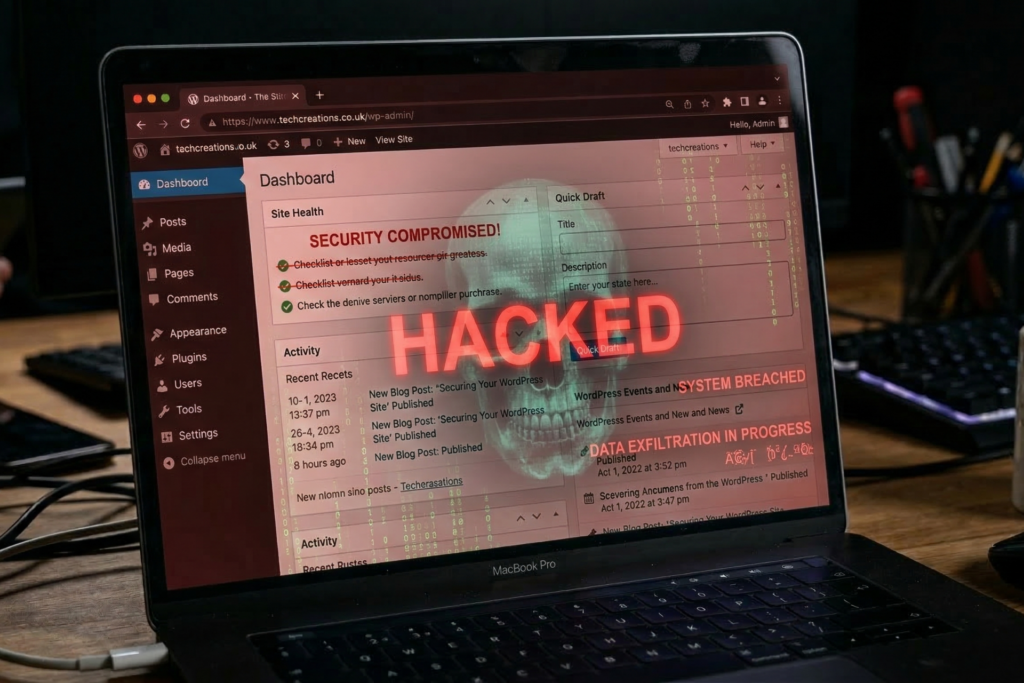
A WordPress site is considered hacked when an attacker gains unauthorized access to modify files, inject malicious code, or control user data. In 2026, the definition has expanded to include unauthorized resource hijacking (using your server power to mine crypto or launch attacks on others).
In many cases, the hack is invisible to the owner:
- Malware runs silently to harvest customer emails for AI-driven phishing.
- SEO spam pages are injected to hijack your hard-earned domain authority.
- Admin access is escalated via session hijacking, bypassing basic passwords.
- Backdoors are planted in the database, allowing reentry even after a “cleanup.”
From an infrastructure perspective, a “hack” is simply unauthorized execution inside your application environment.
Most WordPress sites are compromised through automated bots using AI-enhanced vulnerability scanning. These bots scan thousands of Irish sites per hour looking for these five entry points:
- Supply Chain Vulnerabilities: This is the leading threat in 2026. Hackers buy popular, “abandoned” plugins and push malicious updates to thousands of sites simultaneously.
- Authentication Failure (Beyond Passwords): While weak passwords still exist, modern hacks target the lack of Multi-Factor Authentication (MFA). Without a second layer of verification, a leaked credential is an open door.
- The “Shared Hosting” Contamination: Many providers still use legacy “Shared” environments. If your “neighbor” on the server has a weak site, the malware can spread laterally across the server to yours.
- Outdated Execution Environments: Running on old versions of PHP or outdated server OS layers creates “unpatchable” holes that bots exploit in seconds.
- File Permission Over-Privilege: If a plugin has “Write” access to your entire directory, a single flaw allows a hacker to rewrite your core index.php file.
Most hosting security is marketing because providers focus on visible peripherals like SSL certificates, while ignoring internal isolation where real attacks occur.
Reactive Backups
| Marketing “Security” | Real Infrastructure Security (2026 Standard) |
|---|---|
| Free SSL Certificates | Process-Level Isolation (LVE/Containers) |
| Basic Firewalls | AI-Driven Edge WAF (Web Application Firewall) |
| Scheduled Malware Scans | Real-Time Execution Monitoring |
| Shared Environments | Immutable File Systems & Segmented Architecture |
| Reactive Backups | Proactive Patching & Zero-Trust Access |
A firewall does not protect against a malicious update to a trusted plugin. This is the core disconnect. Many web hosting Ireland providers optimize for cost, not security architecture. Oversold servers and minimal isolation create environments where one weakness becomes a systemic risk.
For businesses in high-stakes sectors, basic security isn’t enough. Learn Why Irish FinTech and Payments Companies Need ISO 27001 Hosting to understand the gold standard of data protection.
With the EU Data Act and evolved GDPR requirements, the cost of “looking the other way” has skyrocketed.
- Financial Impact: Beyond emergency recovery costs, the loss of “Trust Signals” means your conversion rate may never fully recover.
- SEO Devastation: Google’s 2026 algorithms prioritize “Site Health.” A single malware flag can wipe out years of ranking progress in 24 hours.
- Legal Exposure: In Ireland, a data breach involving customer info requires mandatory notification to the Data Protection Commission (DPC).
For businesses relying on web hosting wordpress, security is no longer a technical “add-on.” It is a business survival requirement.

SmartHost replaces marketing promises with Security Engineering. We design environments that eliminate common exploit paths before they can be used.
- Zero-Lateral Movement: We use advanced containerization. Even if one site on a server is compromised, it is physically impossible for the malware to “jump” to another account.
- MFA-First Environments: We provide integrated tools to enforce Multi-Factor Authentication and Passkey support at the server level.
- Proactive Patching (Virtual Patching): When a new plugin vulnerability (CVE) is discovered, our WAF applies a “virtual patch” to block the exploit attempt before you even have time to click “Update” in WordPress.
- NVMe-Backed Performance: Security requires resources. Our high-speed NVMe storage ensures that security scans and encryption processes don’t slow down your user experience.
- Regional Data Sovereignty: All data stays within secure, GDPR-compliant Irish data centers, ensuring full compliance with EU laws.
FAQs



Our team can help
Have further questions, or need some advice about hosting solutions for you and your business?
Our team are on hand to assist you and get your business online. Why not give us a call on (01) 901 9700 or send us an email at support@smarthost.ie. We will get back to you as soon as possible.